aromatheka
Perfume discovery app developed as part of my Bachelor’s thesis in UX Design at SWPS University in Kraków.
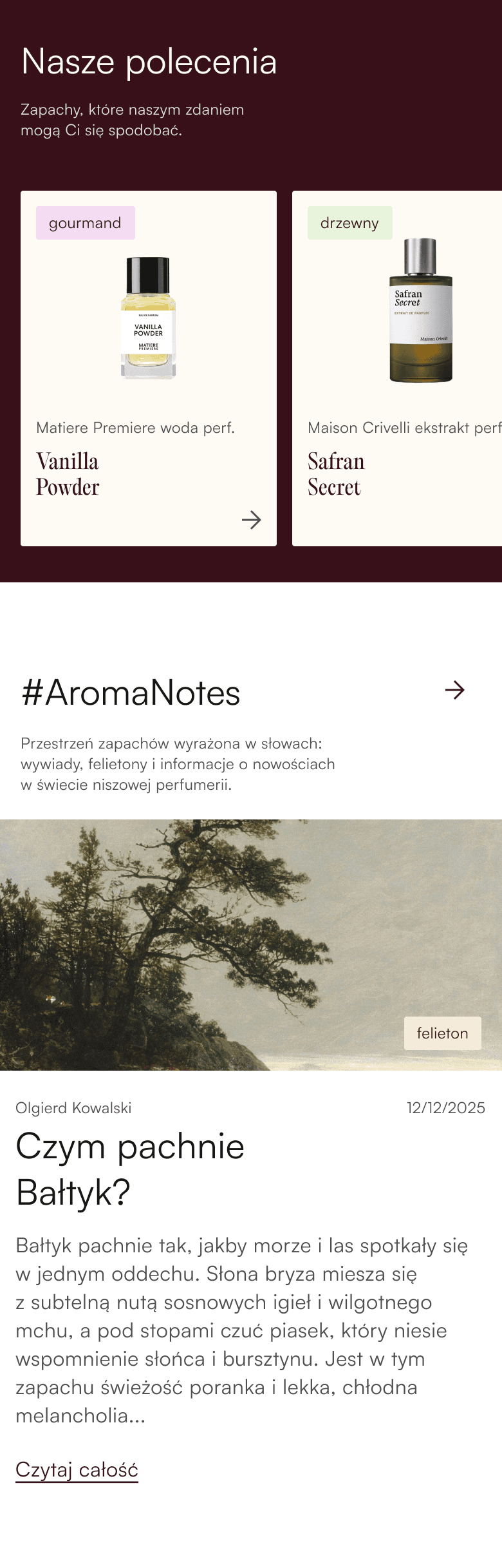
The project addresses the challenge of choosing perfumes online without the ability to physically experience scent. The concept was designed to support nearly the entire fragrance selection journey in one place — from initial discovery and inspiration, through scent evaluation and social validation, to finding the most suitable purchase option.
UX research
UX/UI design
Design system
Branding




Process
I started with a competitor analysis, reviewing platforms like Fragrantica, Parfumo, Notino, Scentbird, Galilu, and Pinterest. The goal was to identify gaps in the market — most existing tools were either technically accurate but emotionally cold, or visually inspiring but disconnected from actual fragrance data. The opportunity was to combine both worlds.
I translated research findings into two personas, a stakeholder map, an empathy map, and a Value Proposition Canvas — establishing a shared understanding of user goals, frustrations, and the value the product needed to deliver.
With the problem space defined, I moved into information architecture. I mapped five primary user flows covering onboarding and personalisation, fragrance exploration, individual scent evaluation, community interaction, and purchase decision-making. A User Story Map helped prioritise features into a coherent MVP scope.
Visual design was guided by the product's positioning at the intersection of aesthetics and utility. I developed a design system with a refined colour palette, typography scale, and component library — enabling consistent UI across the app while leaving room for the rich visual content (moodboards, fragrance imagery, user collections) to breathe.
Key Takeaways
The central design challenge wasn't visual — it was sensory translation. How do you help someone imagine a smell through a screen? The answer came from combining structured fragrance data (notes, projection, longevity) with emotional, image-driven exploration inspired by the logic of Pinterest. Neither alone was sufficient; together, they gave users both inspiration and confidence.
The research also surfaced an underserved audience: buyers who know nothing about perfume but want to give a meaningful gift. Designing for them meant building clear, jargon-free pathways — without dumbing down the experience for enthusiasts.